
- 20 March 2026
-
Kristie Perrotte
For most recruitment agencies, SEO hasn’t historically been their number one recruitment marketing play. Often seen as a tactic reserved for the big recruitment players, job boards or Indeed, (despite its merits), SEO has not been considered a primary strategy for scaling agencies. But GEO for recruitment marketing is changing that!
Search is changing.
AI-powered search experiences are reshaping how information is delivered. Google’s AI Overviews and other answer engines increasingly summarise information before users click through to websites. Visibility now often happens before the click.
For recruitment agencies, the challenge is no longer just ranking well. It is ensuring that AI systems recognise your agency as a trusted source when generating answers.
This is where Generative Engine Optimisation (GEO) and Answer Engine Optimisation (AEO) come into focus.
What Does AEO and GEO for Recruitment Marketing Really Mean?
Traditional SEO is built around ranking pages in search results. GEO and AEO shift the focus towards being referenced and cited within AI-generated answers, whether the top answer results on Google (AEO), or within Generative AI platforms, like ChatGPT (GEO).
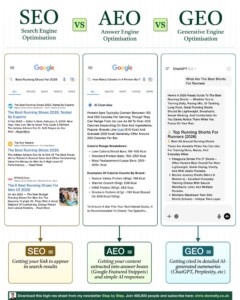
AI platforms analyse multiple sources, synthesise information and present it as a single response. The organisations referenced in those responses effectively become the new “top results”.
Evidence suggests that web mentions can outperform traditional backlinks when it comes to appearing in AI search summaries, reinforcing the importance of authority signals beyond your own website.
Encouragingly, appearing in AI-generated answers does not necessarily require the highest domain authority, which is great for SME recruitment agencies. What matters more is recognised expertise within a clearly defined niche.
For recruitment marketers, optimisation now extends beyond technical SEO into reputation, expertise and visibility across the wider digital ecosystem.
Recruitment SEO for Today
Despite concerns about declining organic traffic across some industries, like publishing, healthcare and local services, GEO for recruitment marketing presents a great opportunity.
AI tools can summarise career advice or hiring insights, but they cannot complete the most important step in the recruitment process: submitting a CV or applying for a job.
This creates a clear click advantage.
Candidates searching for roles such as “project manager jobs London”, “SAP consultant contract roles UK” or “life sciences recruitment agency jobs” still need to visit a website to apply.
However, the broader search landscape is evolving. Informational content that once generated large volumes of traffic is increasingly answered directly by AI systems.
The experience of HubSpot illustrates this shift. The company reportedly saw a 70–80% decline in organic traffic between 2024 and 2025 (over 7 million sessions!), highlighting the risks of relying heavily on high-volume informational searches disconnected from core expertise.
For recruitment agencies, this reinforces the need to focus on intent-driven search visibility rather than traffic alone.
The “Winner Takes Most” Dynamic
AI-driven search is also creating a more concentrated visibility landscape.
When AI systems generate answers, they tend to reference a relatively small number of trusted sources. Those sources are then cited repeatedly because they have already been identified as authoritative.
For recruitment agencies, authority signals therefore matter more than ever.
Examples include:
- Visible personal brands within the agency
- LinkedIn thought leadership from consultants
- Sector-specific expertise and insights
- Dedicated solutions pages by industry
The agencies that consistently demonstrate expertise in a particular niche are far more likely to appear in AI-generated answers.
Authority Signals and E-E-A-T
Search engines and AI systems increasingly evaluate credibility through the E-E-A-T framework: Experience, Expertise, Authoritativeness and Trustworthiness.
For recruitment agencies, strengthening these signals should be a strategic priority.
Practical ways to do this include featuring named experts within content, adding structured author bios and showcasing real-world recruitment experience. Detailed case studies and testimonials further reinforce credibility.
External mentions also play an important role. Appearances in industry publications, events or communities signal that your expertise is recognised beyond your own website.
In effect, many traditional brand awareness activities now function as AI citation signals.
Recruitment Search Strategy for the AI Search Era
Adapting to AEO and GEO for recruitment marketing does not require abandoning established marketing principles. In many ways, it simply reinforces the importance of genuine expertise and strategic clarity.
However, recruitment agencies must become more deliberate about how their expertise is communicated online.
-
Sharpen Your Niche Positioning
Agencies that attempt to serve every industry equally often struggle to demonstrate clear authority.
AI systems are far more likely to reference organisations that consistently show expertise within a specific sector. Defining a strong niche – such as life sciences, technology or finance recruitment – helps establish that credibility.
Specialisation also makes content more distinctive, allowing agencies to stand out from generic recruitment advice. Instead of optimising for “how to write a CV”, think “how to write an engineering CV that gets noticed by UK aerospace employers” or “how to write a CV for a senior civil engineering role in infrastructure projects.”
-
Strengthen Service and Role Pages
Many recruitment websites rely on templated service pages that describe recruitment processes in broad terms.
These pages should instead showcase real market expertise. This might include discussing hiring challenges within an industry, analysing talent shortages or exploring salary expectations.
When service pages demonstrate genuine insight, they become valuable resources for both search engines and AI answer systems.
-
Document Measurable Case Studies
Case studies remain one of the most effective ways to demonstrate experience.
Rather than telling a general story, strong case studies highlight measurable outcomes. For example, they might show how an agency filled difficult roles quickly, reduced time-to-hire or supported a client during rapid growth.
These tangible results reinforce the credibility signals that AI systems rely on when identifying trusted sources.
-
Maintain Strong Technical Foundations
Technical SEO still underpins discoverability. Schema markup, internal linking and topic clusters help search engines and AI systems understand how your expertise is structured.
For recruitment agencies producing insights, salary reports or hiring guides, these technical elements help reinforce topic authority.
-
Invest in Original Research
Original research remains one of the strongest authority signals available.
Salary reports, hiring trend analyses and talent market insights provide information that does not exist elsewhere. As a result, they are frequently cited by media outlets, analysts and increasingly by AI-generated search responses.
For agencies already sitting on valuable hiring data, turning that data into published research can significantly strengthen visibility.
-
Distribute Content Across Multiple Channels
Visibility today extends beyond your website.
LinkedIn thought leadership, guest articles, podcasts and webinars all contribute to the wider network of mentions that AI systems analyse when determining authority.
A strong distribution strategy ensures your expertise appears across multiple trusted platforms.
-
Measuring Recruitment Marketing Impact
While organic traffic remains important, it should not be the primary measure of success.
Organic search still accounts for around 53% of website traffic, but conversion rates are rising as searches become more intent-driven.
Recruitment marketers should therefore focus on metrics that link marketing activity directly to revenue. These include brand search growth, marketing-assisted placements, lead-to-placement ratios and pipeline value.
Ultimately, the effectiveness of recruitment marketing should always be judged by its contribution to successful placements.
The Future of Recruitment Marketing in an AI Search World
AI-driven search is not removing the need for recruitment marketing. Instead, it is raising the importance of credibility, expertise and strategic focus.
Agencies that produce generic content will find it increasingly difficult to stand out. Those that demonstrate clear expertise within specific industries will gain visibility more easily – if they operate with intention. Developing a marketing strategy and plan is critical for success here.
Importantly, many recruitment businesses have yet to adapt their strategies to this shift. That creates an opportunity for agencies willing to invest in authority-building now.
Search has always rewarded trust and expertise. AI search simply makes those qualities more visible.
For recruitment agencies, success will come from ensuring their expertise is recognised not just by search engines, but by the AI systems shaping how people discover information.